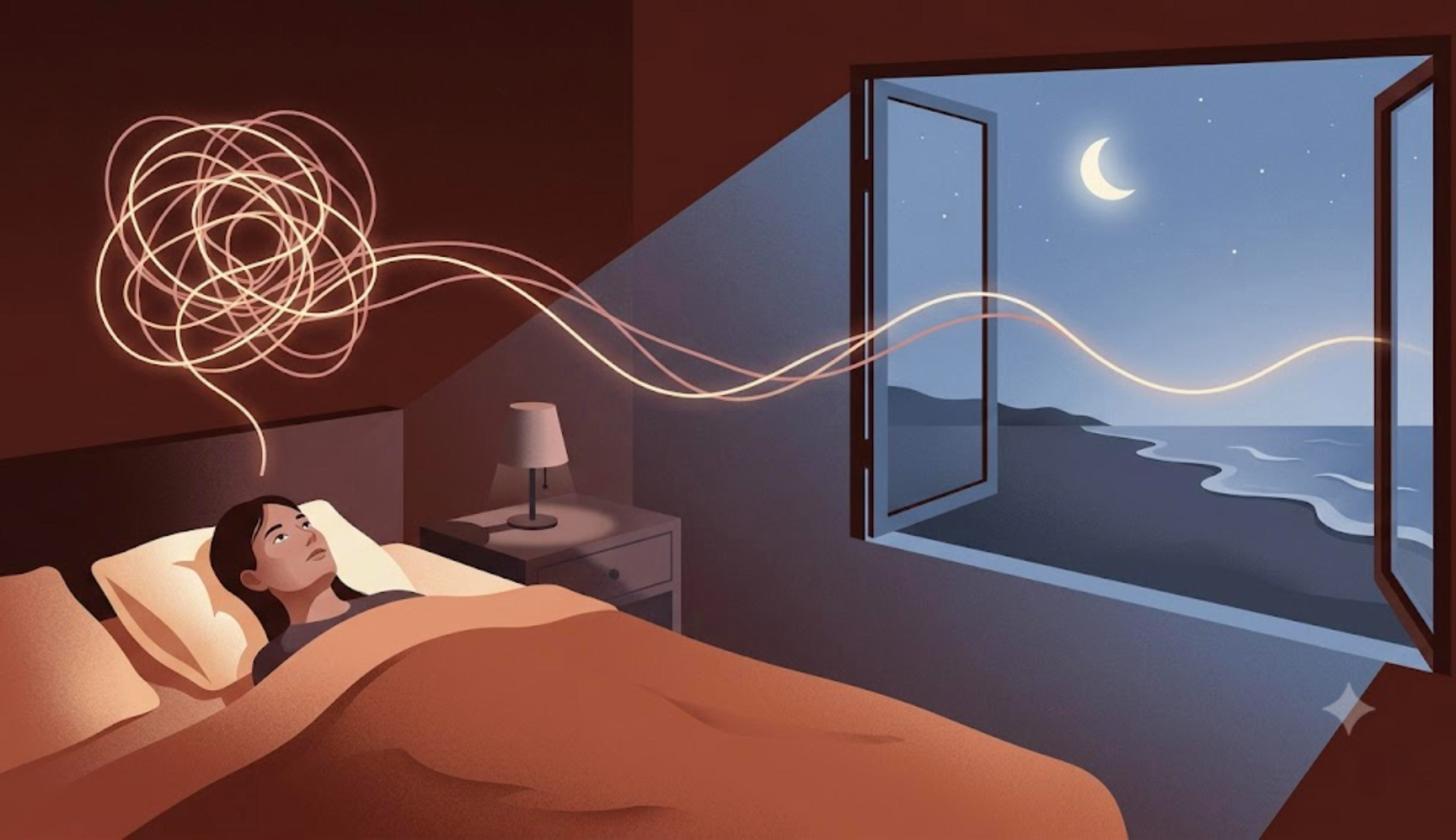
The day is over, the lights are off, and that's exactly when your brain decides to replay an awkward conversation, plan next week and worry about something that won't matter in a month. It's one of the most common reasons people lie awake.
The good news is that overthinking at night is well studied, and some approaches work much better than others. Here's why it happens and eight things that help, starting with the one that sounds the most obvious and doesn't work.
Why your mind races at night
During the day, your attention is pulled in a hundred directions. In bed, in the dark, there's nothing else to focus on, so unfinished business rises to the surface.
Sleep researchers describe a vicious cycle. Worrying makes you more alert, both mentally and physically. You notice you're awake, and that becomes a new worry: "I need to sleep, I've got a big day tomorrow." That keeps you even more alert (Harvey, 2002). The aim isn't to empty your mind. It's to break that loop.
1. Stop trying to stop the thoughts
When a thought won't go away, the natural reaction is to push it out. It backfires. In one study, people who were told to suppress a worrying thought before sleep rated their sleep as taking longer to arrive and as poorer quality than people who were told to let their thoughts come and go. That was true for good sleepers as well as people with insomnia (Harvey, 2003).
Try this instead: notice the thought, name it ("there's the work worry again"), and let it drift past without arguing with it. You're not trying to solve it or banish it, just to stop wrestling with it.
2. Give your worries an appointment earlier in the evening
If the same worries come back every night, deal with them before bed. A technique called constructive worry reduced how mentally wound-up people with insomnia felt at bedtime (Carney and Waters, 2006).
- In the early evening, at least a couple of hours before bed, sit down with a sheet of paper for about 15 minutes.
- Draw two columns.
- On the left, write each thing that's on your mind.
- On the right, write the next small step you could take on it, even if that step is "ask Sam on Monday" or "nothing I can do about this tonight".
- Fold the paper and put it away.
| Worry | Next step |
|---|---|
| The report is due Friday | Block two hours tomorrow morning |
| I said something awkward to Priya | Message her tomorrow, or let it go; it's probably fine |
| Money's tight this month | Look at the budget on Saturday |
When that worry turns up in bed, you can tell yourself: "I've already dealt with that. It's on the list."
3. Write tomorrow's to-do list
A to-do list is a lighter version of the same idea. In a sleep lab study, people who spent five minutes writing a specific to-do list before bed fell asleep faster than those who wrote about tasks they'd already done (Scullin et al., 2018). Getting tomorrow's jobs onto paper seems to stop your brain from rehearsing them.
4. Picture a calm, detailed scene
Your mind needs something to do, so give it a job that's interesting enough to hold your attention, but not so exciting that it wakes you up. In one study, people with insomnia who were asked to imagine a pleasant, absorbing scene fell asleep faster and had less unpleasant thinking before sleep than people told to distract themselves however they liked, or given no instructions (Harvey and Payne, 2002).
Pick a place you find relaxing, such as a beach, a forest walk or a favourite room, and build it in detail:
- What can you see? The colours, the light, the textures.
- What can you hear? Waves, wind, birds, distant voices.
- What can you feel? Warm sand, cool air, a soft blanket.
- Walk through it slowly, noticing one detail after another.
If you drift back to a worry, gently return to the scene.
5. Try cognitive shuffling
Cognitive shuffling is a newer twist on the same idea. Pick a random, neutral word, such as "bedtime". For each letter, think of words that start with it and briefly picture each one: b... banana, bicycle, button... then e... elephant, envelope... and so on. The random, harmless images are meant to mimic the drifting, disconnected thoughts we have just before sleep.
Many people find it surprisingly effective. Be aware that the research is still early and comes mostly from the psychologist who developed it, so treat it as something worth trying rather than a proven method.
6. Slow your breathing down
Racing thoughts and fast, shallow breathing feed each other. Slow breathing with a long exhale is linked to feeling calmer. Try breathing in for 4 and out for 6 for a few minutes, or follow our step-by-step guide to the 4-7-8 breathing method. Counting the breaths also gives your mind something simple to hold on to.
7. Get up if you're stuck
If you've been lying there churning for what feels like about 20 minutes, get up. Go to another room, keep the lights dim, and do something quiet and dull until you feel sleepy. Staying in bed while frustrated teaches your brain that bed is a place for worrying. Our guide to what to do when you can't sleep explains this and 11 other tips.
8. Give your mind a soft sound to rest on
Silence can make thoughts feel louder. A steady, gentle sound such as rain or soft brown noise gives your attention something neutral to settle on, and it covers the small noises that can set off a new train of thought.
Play brown noise nowFree in your browser, with a sleep timer that fades outKeep it quiet, and use a timer so it fades out once you're asleep. Not sure which sound to choose? Our guide to brown noise vs white noise can help.
What doesn't help
- Scrolling your phone. It feels like a distraction, but bright light and endless content keep your brain switched on.
- Trying to solve problems in bed. Nothing gets solved at 2 AM. Problems feel bigger in the dark and smaller in the morning.
- Checking the time. It turns into a countdown that adds pressure.
- A nightcap. Alcohol may help you nod off, but it tends to break up your sleep later in the night.
When it's more than overthinking
How nive can help
nive is designed for this part of the night. In the nive app, pick a soft mix such as rain on a window, a slow fireplace or gentle brown noise. Then open Breathe and follow a couple of minutes of 4-7-8 or box breathing, or picture your calm scene with the sound in the background, and let Sleep Mode fade it out slowly once you're asleep. You can also set a bedtime nudge, which reminds you 30 minutes before your wind-down time. That's a good moment to write your to-do list.
FAQ
Why do I overthink at night?
At night there's nothing else competing for your attention, so unfinished worries surface. Worrying makes you more alert, and noticing you're awake becomes another worry, which creates a loop. Being tired also makes it harder to put thoughts in perspective.
How do I stop my mind racing when I'm trying to sleep?
Don't try to force thoughts out, because that tends to backfire. Instead, deal with worries earlier with a to-do list or "constructive worry", picture a calm, detailed scene, slow your breathing, and get up for a while if you're still awake after about 20 minutes.
Is overthinking at night a sign of anxiety?
Not necessarily. Most people overthink at night sometimes. But if it happens most nights, or comes with worry, tension or low mood during the day, it's worth talking to a doctor, as it can be part of anxiety or depression, which are very treatable.
Does writing things down before bed really help?
There's good evidence that it does. In one sleep lab study, writing a specific to-do list before bed helped people fall asleep faster. A structured "constructive worry" exercise earlier in the evening also reduced how wound-up people felt at bedtime.
What is cognitive shuffling?
It's a technique where you pick a random word and, for each letter, imagine a series of unrelated, neutral objects. It's meant to mimic the drifting thoughts you have as you fall asleep. Many people find it helpful, but the research is still limited.
Should I get out of bed if I can't stop thinking?
Yes, if you've been lying awake for around 20 minutes. Do something calm in dim light in another room and come back when you feel sleepy. It stops your brain linking your bed with lying awake and worrying.
Sources
- Harvey AG. A cognitive model of insomnia. Behaviour Research and Therapy, 2002.
- Harvey AG. The attempted suppression of presleep cognitive activity in insomnia. Cognitive Therapy and Research, 2003.
- Carney CE, Waters WF. Effects of a structured problem-solving procedure on pre-sleep cognitive arousal in college students with insomnia. Behavioral Sleep Medicine, 2006.
- Scullin MK, et al. The effects of bedtime writing on difficulty falling asleep: a polysomnographic study comparing to-do lists and completed activity lists. Journal of Experimental Psychology: General, 2018.
- Harvey AG, Payne S. The management of unwanted pre-sleep thoughts in insomnia: distraction with imagery versus general distraction. Behaviour Research and Therapy, 2002.
This article is for general information and isn't medical advice. nive is a relaxation app, not a treatment for insomnia, anxiety or any other condition.
Take it to bed with you
nive mixes up to six sounds, fades them to silence with Sleep Mode, works offline and plays on Google Cast, AirPlay and Alexa. Free on iPhone and Android with no ads; Premium is $0.99 a month or $9.99 a year, with a 7-day free trial.