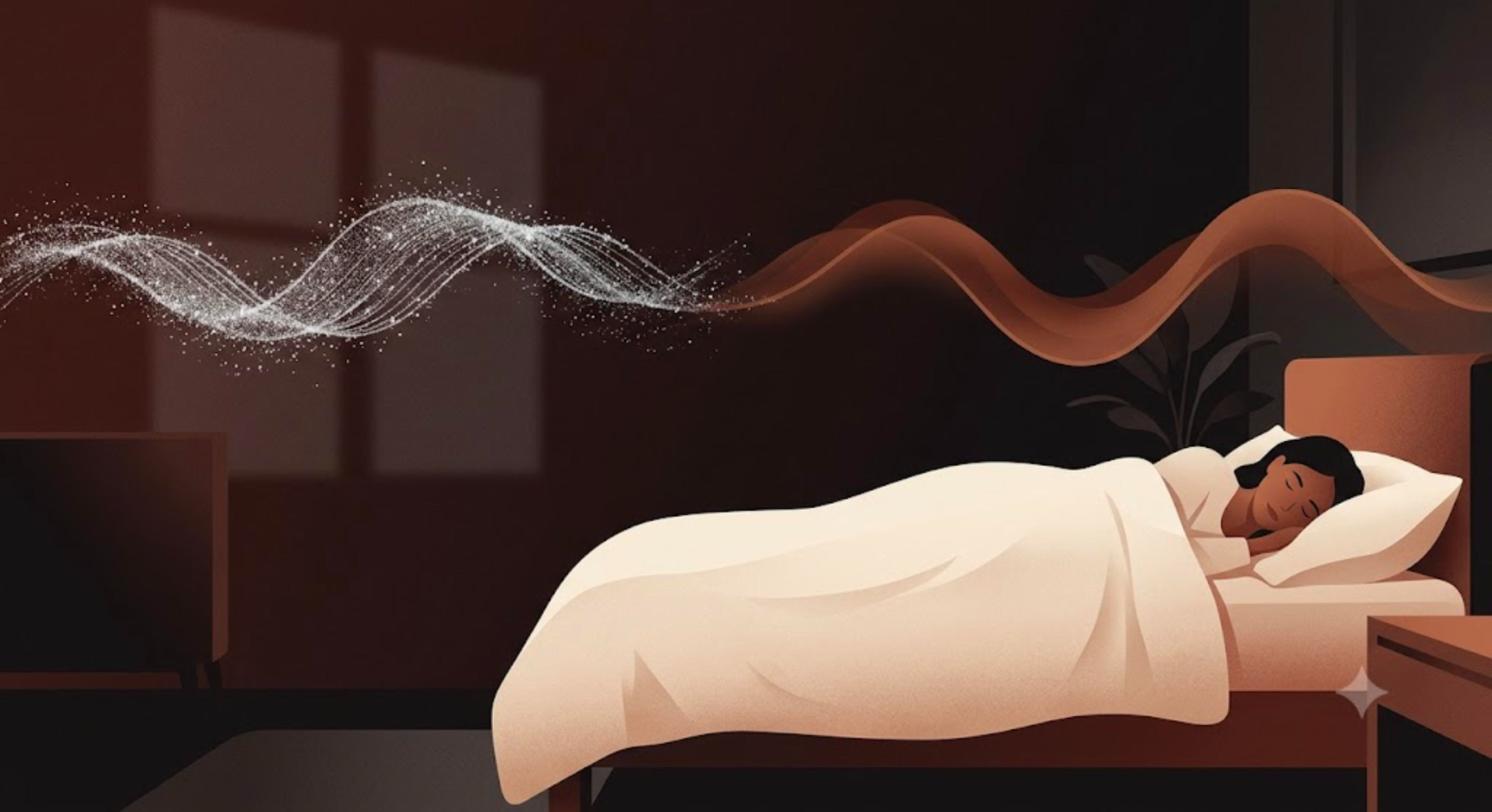
If you've ever lain awake scrolling through "white noise vs brown noise" threads at 1 AM, you've probably found two camps. One says white noise is the classic and nothing beats it. The other says white noise is harsh and brown noise changed their life.
Both camps are partly right. They're describing different sounds that do different jobs, and the science behind either one is far less settled than the internet suggests. Here's what actually separates them, what the studies say, and a simple way to find out which one works for you.
The short answer
For most adults, brown noise is the easier one to sleep with, and white noise is the stronger mask.
Brown noise has very little high-pitched hiss, so many people find they can listen to it for hours without it getting on their nerves. White noise is fuller in the frequencies where speech and sharp sounds live, so it does a better job of hiding voices, a TV next door or a dog barking down the street.
If you're unsure, start with brown noise at a low volume. If you can still hear the sound you're trying to block, try pink noise, which sits between the two, before you jump to white.
Play brown noise nowFree in your browser, with a sleep timer that fades outWhat's the actual difference?
All "coloured" noise is random sound. What changes from colour to colour is how its energy is spread across low and high pitches.
- White noise has equal power at every frequency, like white light containing every colour. Because each octave up holds twice as many frequencies as the one below it, most of white noise's energy ends up in the high end. That's why it sounds like shhhh rather than a rumble.
- Pink noise loses about 3 decibels of power with every octave you go up. That balances the energy across octaves, so it sounds smoother and more natural, like steady rain or wind in leaves.
- Brown noise loses about 6 decibels per octave, twice as fast as pink. The hiss is almost gone and what's left is a low roar, like a waterfall heard from a distance or the hum inside a plane cabin.
Brown noise isn't named after the colour. It's named after the botanist Robert Brown and Brownian motion, the random drifting movement of particles in a fluid. The signal wanders in the same way. It's sometimes called red noise, too.
There's also a reason white noise can feel more grating than it "should". Human hearing is most sensitive to the middle-to-high range, roughly 2,000 to 5,000 Hz, which is exactly where white noise is strongest. Brown noise keeps most of its energy in the lows, where our ears are less sensitive, so it feels softer at the same setting.
Brown noise vs white noise, side by side
| White noise | Pink noise | Brown noise | |
|---|---|---|---|
| Sounds like | TV static, a hissing tap, a fan on high | Steady rain, wind in trees | A distant waterfall, a plane cabin, heavy surf |
| Energy | Equal at every frequency | Drops 3 dB per octave | Drops 6 dB per octave |
| Best at covering | Voices, TV, birds, sharp clicks | A bit of everything | Traffic, bass, snoring, rumbling pipes |
| Common complaint | "Too harsh", "sounds like hiss" | "Not strong enough for loud rooms" | "Doesn't block voices" |
| Try it first if | Your problem is talking, TV or dawn birds | You want a middle ground | You're sensitive to hiss or the noise is low and rumbly |
What the research actually says
This is where most articles get vague, so here's an honest summary.
There is some evidence that steady background sound helps people fall asleep faster. In a small randomised trial at Brigham and Women's Hospital, 18 healthy adults slept two nights in a lab. To mimic a bad night, they went to bed 90 minutes earlier than usual. On the night with broadband sound playing, the time it took them to fall asleep dropped from about 19 minutes to 13, which the authors report as a 38% reduction (Messineo et al., 2017). Worth noticing: the sound was played at just 46 dB, only slightly louder than the quiet room itself.
But the bigger picture is mixed. In 2021, researchers at the University of Pennsylvania reviewed 38 studies on continuous noise and sleep. They rated the quality of the evidence as very low. Some studies found that noise helped and at least one found it made sleep worse, and the studies differed too much in their methods to draw firm conclusions (Riedy et al., 2021). In short, noise isn't proven to improve sleep for everyone, and it isn't proven harmless either.
Brown noise in particular has almost no direct sleep research. Its popularity exploded on social media in 2022, well ahead of any studies. Most of what's said about it is borrowed from white and pink noise research or comes from personal experience. That doesn't mean it doesn't work for you. It means nobody can promise you it will.
How to choose: a three-night test
Because the evidence can't pick for you, your own ears are the best tool. Try this:
- Night one: brown noise. Set it just loud enough that the sound bothering you blends in, not so loud that it's covered completely.
- Night two: pink noise, at the same volume rule.
- Night three: white noise, at the same volume rule.
Each morning, rate two things from 1 to 5: how quickly you think you fell asleep, and how rested you feel. Ignore which one felt "nicest" while you were awake. The winner is the one you stopped noticing fastest, with the best morning score.
Play pink noise nowFree in your browser, with a sleep timer that fades outWhich one for which problem?
| Your situation | Try first | Why |
|---|---|---|
| Road or train noise | Brown | Traffic is mostly low-frequency rumble, which brown noise covers well |
| A partner who snores | Brown, then pink | Snoring is low and uneven, so a deep steady sound blends with it |
| Neighbours talking, TV through the wall | White or pink | Speech sits in the mid-to-high range, where white noise is strongest |
| Birds at dawn, early-morning traffic | Pink or white | Birdsong is high-pitched |
| You find white noise harsh or tiring | Brown | Almost no high-frequency hiss |
| Ringing in your ears (tinnitus) | Ask an audiologist | Sound therapy for tinnitus is matched to your hearing, and a doctor should check the cause |
| Studying or focusing | Whichever you can ignore | See the FAQ below on focus and ADHD |
How loud is too loud?
Whichever colour you choose, volume matters more than colour.
- Quieter than you think. The trial above used 46 dB, just above the hush of a quiet library. Aim for something you can easily talk over, never something you have to raise your voice above.
- Mind the hours. The WHO and ITU's safe listening standard for headphones and personal audio sets an adult limit of 80 dB averaged over 40 hours a week (WHO–ITU H.870). A full night, every night, adds up to more than 40 hours, so all-night sound should be far quieter than that.
- Babies need extra care. When researchers tested 14 infant sleep machines at full volume, every one went above the 50 dB limit recommended for hospital nurseries when measured 30 cm away, the distance of a cot rail, and three went above 85 dB (Hugh et al., 2014). Keep a machine or phone well away from the cot, never in it or on the rail, and keep the volume low.
- Fade out, don't cut out. If you only need help falling asleep, there's no reason to keep the noise going until morning. A fade-out timer gives you the help when you need it and silence once you're asleep. A gradual fade is also less likely to wake you than a sudden stop.
Making it work with nive
You don't have to choose just one sound. In the nive app, you can layer brown noise with rain, set brown noise against a soft fan, or keep a little pink noise under ocean waves. Then Sleep Mode lowers the volume a tiny amount every minute until the room is silent, so the sound is there while you drift off and gone once you're asleep. Mixes work offline too, which is handy in a hotel room or on a plane.
If you just want to try the three colours tonight, the free white, pink and brown noise players on this site run in your browser, with a sleep timer and no sign-up.
FAQ
Is brown noise better than white noise for sleep?
Not for everyone, but many people find it easier to sleep with. Brown noise has much less high-pitched hiss, so it's less tiring to listen to for hours. White noise is better at covering voices and sharp sounds. Try both at a low volume and keep the one you stop noticing.
Is it bad to sleep with white noise every night?
There's no strong evidence that low-volume white noise is harmful, but there's no strong evidence that it helps everyone either. A 2021 review rated the research as very low quality. Keep it quiet, keep the speaker away from your head, and use a fade-out timer if you only need help falling asleep.
Does brown noise help with ADHD or focus?
Possibly, for some people, but it hasn't been tested directly. A 2024 meta-analysis of 13 studies found a small benefit from white and pink noise on attention tasks in people with ADHD, and it found no studies on brown noise at all. Background noise isn't a treatment for ADHD. If it helps you focus, though, there's no harm in using it at a sensible volume.
Which is better for babies, white noise or brown noise?
There's no good research comparing them for babies. What matters most is volume and distance. Keep any sound machine well away from the cot, at a low volume, and consider switching it off once your baby is asleep.
What's the difference between white, pink and brown noise?
They're all random sound with their energy spread differently. White noise is equal across every frequency and sounds hissy. Pink noise drops by 3 dB per octave and sounds like steady rain. Brown noise drops by 6 dB per octave and sounds like a deep rumble.
Should I play noise all night or use a timer?
If you wake up during the night because of noise, such as early traffic or a snoring partner, keeping a quiet sound on all night can help. If you only struggle to fall asleep, use a timer that fades the sound out gradually, so you get less exposure overall and no sudden silence to wake you.
Sources
- Messineo L, et al. Broadband sound administration improves sleep onset latency in healthy subjects in a model of transient insomnia. Frontiers in Neurology, 2017.
- Riedy SM, Smith MG, Rocha S, Basner M. Noise as a sleep aid: a systematic review. Sleep Medicine Reviews, 2021.
- Nigg JT, et al. Systematic review and meta-analysis: do white noise and pink noise help with attention in ADHD? Journal of the American Academy of Child & Adolescent Psychiatry, 2024.
- Hugh SC, et al. Infant sleep machines and hazardous sound pressure levels. Pediatrics, 2014.
- World Health Organization and ITU. Safe listening devices and systems: a WHO–ITU standard, 2019.
This article is for general information and isn't medical advice. nive is a relaxation app, not a treatment for insomnia or any other condition.
Take it to bed with you
nive mixes up to six sounds, fades them to silence with Sleep Mode, works offline and plays on Google Cast, AirPlay and Alexa. On Android now with a 7-day free trial, then $2.99 a month or $19.99 a year.
Start your free trial