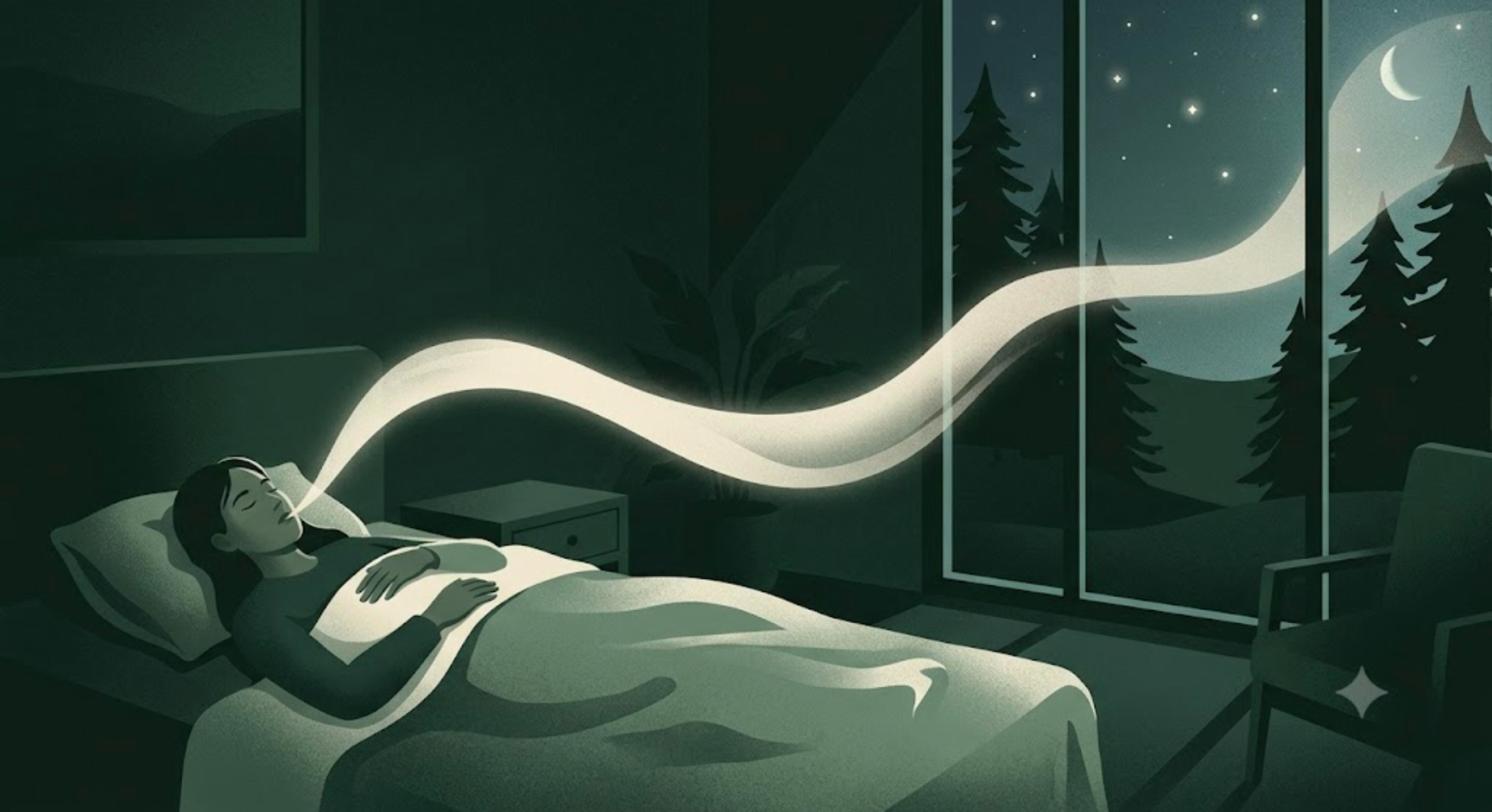
You've probably heard 4-7-8 breathing described as the trick that knocks you out in a minute. It won't do that for most people. What it can do is slow your breathing, give a busy mind something simple to follow, and help your body shift into a calmer state, which is exactly what you need before sleep.
Here's how to do it properly, how to adapt it if the counts feel wrong, and what the research actually shows.
What is 4-7-8 breathing?
4-7-8 breathing is a slow breathing pattern with a short inhale, a long hold and an even longer exhale. It was popularised by the American physician Dr Andrew Weil, who adapted it from pranayama, the breath-control practices of yoga. He calls it the "relaxing breath".
Each round takes about 19 seconds at the standard pace, so you breathe only around three times a minute. The exhale is twice as long as the inhale, and that long, slow breath out is a big part of why it feels so settling.
How to do 4-7-8 breathing, step by step
These steps follow Dr Weil's own instructions (Arizona Center for Integrative Medicine).
- Get comfortable. Sit with your back straight while you're learning. Once you know it, you can do it lying down in bed.
- Place your tongue. Rest the tip of your tongue on the ridge just behind your upper front teeth, and keep it there the whole time.
- Breathe out fully through your mouth, around your tongue, with a soft whoosh.
- Close your mouth and breathe in quietly through your nose for a count of 4.
- Hold your breath for a count of 7.
- Breathe out through your mouth with a whoosh for a count of 8.
- That's one breath. Repeat three more times, for four breaths in total.
| Step | What you do | Count |
|---|---|---|
| Inhale | Through your nose, mouth closed | 4 |
| Hold | Gently, without straining | 7 |
| Exhale | Through your mouth, with a soft whoosh | 8 |
If it feels hard at first
- Feeling light-headed? That's common in the first few tries, and it usually passes. Stop, breathe normally, and next time count faster or do fewer rounds.
- Can't hold for 7? Speed up your counting, keeping the same ratio. You can also try 3-5-6 until it feels easier.
- Exhaling around your tongue feels odd? Purse your lips slightly as you breathe out.
- Don't overdo it. Dr Weil suggests no more than four breaths at a time for the first month, practised at least twice a day. Later you can build up to eight.
Using 4-7-8 breathing to fall asleep
The best way to use 4-7-8 for sleep is as a wind-down signal, not a knockout switch.
- Once you're in bed with the lights off, do four rounds of 4-7-8.
- Then let your breathing go back to normal. Don't count any more; just notice it slowing down on its own.
- If your mind starts to race again, do another four rounds.
- If you're still wide awake after about 20 minutes, get up and do something calm in dim light. Our guide to what to do when you can't sleep explains why that works better than lying there.
Practising during the day helps too. Once the pattern feels automatic, it's much easier to use at 2 AM, when counting feels like hard work.
Play rain sounds nowFree in your browser, with a sleep timer that fades outWhy it might help you relax
Nothing about the numbers 4, 7 and 8 is special. A few features of the pattern do the work:
- It's slow. At about three breaths a minute, it's far slower than normal resting breathing of around 12 to 20. Slow breathing is linked to a calmer nervous system and feeling more relaxed.
- The exhale is long. In a 2023 Stanford study, a breathing technique built around long exhales improved mood and slowed breathing more than mindfulness meditation did (Balban et al., 2023).
- Counting keeps your mind busy. Following the counts leaves less room for the thoughts that keep you awake.
What the research says
The research on 4-7-8 breathing specifically is small but encouraging:
- It calms the body quickly. In a 2022 study of 43 healthy young adults, a few sets of 4-7-8 breathing lowered heart rate and blood pressure straight away, and shifted heart rate variability towards a more relaxed pattern, especially in people who weren't sleep-deprived (Vierra et al., 2022).
- It can reduce anxiety. In a randomised trial of 90 patients recovering from weight-loss surgery, those who practised 4-7-8 breathing reported lower anxiety than a group who received only routine care (Aktaş and Eskici İlgin, 2023).
4-7-8 breathing vs box breathing
| 4-7-8 breathing | Box breathing | |
|---|---|---|
| Pattern | In 4, hold 7, out 8 | In 4, hold 4, out 4, hold 4 |
| Breaths per minute | About 3 | About 4 |
| Feels | Heavy, slow, sleepy | Even, steady, focusing |
| Best for | Winding down at night | Staying calm before or after stress |
Many people like box breathing during the day and 4-7-8 at night. If holding your breath feels uncomfortable, try simply breathing in for 4 and out for 8, without the hold. Our guide to box breathing covers that technique in detail.
Who should be careful
Pair it with a calm sound
A breathing exercise works best in a quiet, comfortable space. In the nive app, start a soft mix such as rain on a window, gentle waves or a low brown noise, then open Breathe and choose the 4-7-8 rhythm: the light guides each count, so you don't have to keep track. After your four rounds, let Sleep Mode fade the sound to silence once you've drifted off. You don't have to remember to turn anything off.
For a quick start tonight, the free rain sounds player runs in your browser, with a sleep timer and no sign-up.
FAQ
Does 4-7-8 breathing really help you sleep?
It helps many people relax, which makes falling asleep easier. Small studies show it can lower heart rate and anxiety. But there's no large trial showing it makes you fall asleep faster, and claims that it works in 60 seconds aren't backed by evidence.
How many times should I do 4-7-8 breathing?
Start with four breaths at a time, at least twice a day. Dr Weil suggests staying at four breaths for the first month, then building up to eight if you want to. At bedtime, do four rounds and then breathe normally.
Why does 4-7-8 breathing make me dizzy?
Changing your breathing pattern can make you feel light-headed at first, especially if you breathe in too deeply. It usually passes with practice. Count faster, breathe in more gently, or do fewer rounds. Stop and breathe normally if it doesn't go away.
What if I can't hold my breath for 7 seconds?
Count faster. The 4:7:8 ratio matters more than the exact number of seconds. You can also use a shorter version such as 3-5-6, or drop the hold and just breathe in for 4 and out for 8.
Is 4-7-8 breathing better than box breathing?
Neither is better overall. 4-7-8 has a longer exhale and feels slower and heavier, so many people prefer it at bedtime. Box breathing is more even and suits calming down during the day. Use whichever you'll actually practise.
Can I do 4-7-8 breathing lying down?
Yes. Learn it sitting up with a straight back, then do it lying in bed once you're comfortable with the pattern.
Sources
- Weil A. Breathing exercises: 4-7-8 (relaxing) breath. Andrew Weil Center for Integrative Medicine, University of Arizona.
- Vierra J, Boonla O, Prasertsri P. Effects of sleep deprivation and 4-7-8 breathing control on heart rate variability, blood pressure, blood glucose, and endothelial function in healthy young adults. Physiological Reports, 2022.
- Aktaş GK, Eskici İlgin V. The effect of deep breathing exercise and 4-7-8 breathing techniques applied to patients after bariatric surgery on anxiety and quality of life. Obesity Surgery, 2023.
- Balban MY, Neri E, Kogon MM, et al. Brief structured respiration practices enhance mood and reduce physiological arousal. Cell Reports Medicine, 2023.
This article is for general information and isn't medical advice. nive is a relaxation app, not a treatment for insomnia, anxiety or any other condition.
Take it to bed with you
nive mixes up to six sounds, fades them to silence with Sleep Mode, works offline and plays on Google Cast, AirPlay and Alexa. Free on iPhone and Android with no ads; Premium is $0.99 a month or $9.99 a year, with a 7-day free trial.