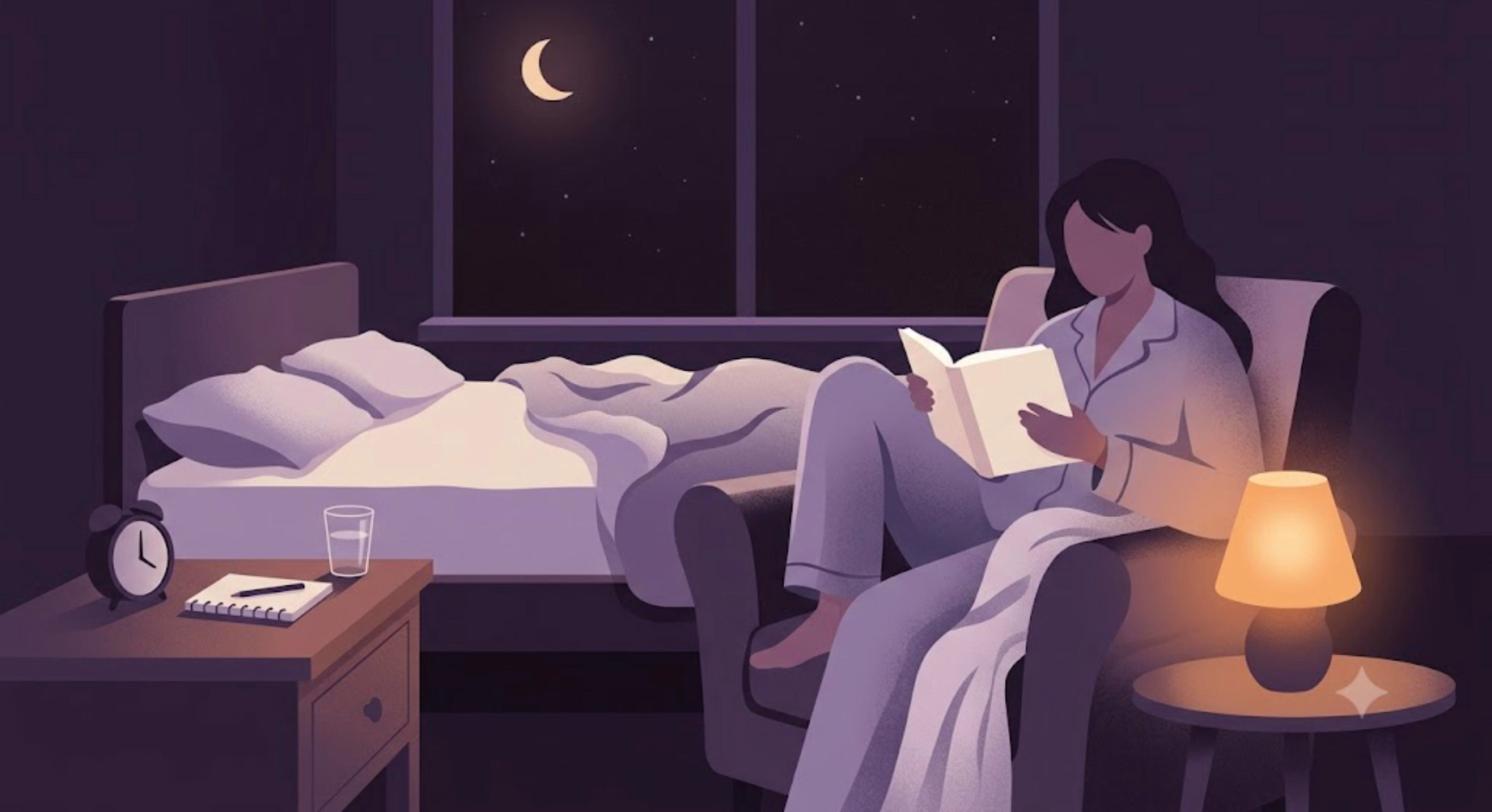
It's late, you're tired, and you can't sleep. The harder you try, the more awake you feel, and every glance at the clock makes it worse.
This guide is for right now. Here are 12 things you can try tonight, roughly in the order you might use them, each with the reason it helps. None of them needs a prescription, and most take less than five minutes.
1. Get out of bed if you've been awake for 20 minutes
It sounds backwards, but it's one of the most effective things you can do. Lying in bed frustrated teaches your brain that bed is a place for being awake and worrying.
If you've been awake for what feels like about 20 minutes (don't check), get up. Go to another room, keep the lights dim, and do something quiet and dull: read a paper book, fold laundry or listen to something calm. Go back to bed when you feel sleepy, and repeat as often as you need to.
This is called stimulus control, and the American Academy of Sleep Medicine recommends it as a treatment for insomnia (Edinger et al., 2021).
2. Turn the clock around
Clock-watching keeps you awake. In one experiment, people who were asked to watch a clock while trying to fall asleep worried more and took longer to fall asleep than people who didn't. That was true for good sleepers as well as poor ones (Tang, Schmidt and Harvey, 2007).
Turn the clock to face the wall and put your phone out of reach. You don't need to know that it's 2:47 AM. That number only gives your mind something new to worry about.
3. Write tomorrow's to-do list
If your mind keeps running through everything you need to do, get it onto paper. In a sleep lab study, young adults who spent five minutes writing a to-do list for the next few days fell asleep faster than those who wrote about tasks they'd already finished. The more specific their list, the faster they fell asleep (Scullin et al., 2018).
Keep a notebook by the bed. Write the list, close the book, and remind yourself that it's handled until morning.
4. Slow your breathing
Slow breathing, at fewer than 10 breaths a minute, is linked to feeling calmer and more relaxed. Try breathing in through your nose for 4 seconds and out through your mouth for 6, for a few minutes. A longer exhale tends to feel more settling than a hold.
If you prefer more structure, our guide to box breathing walks you through the four-count version. At bedtime, many people find a gentler rhythm without breath holds easier.
5. Relax your body, one muscle group at a time
Progressive muscle relaxation is another technique the sleep academy suggests for insomnia. Starting at your feet, tense a group of muscles for about 5 seconds, then let go completely for 10 to 15 seconds and notice the difference. Work up through your calves, thighs, stomach, hands, arms, shoulders and face.
It gives your mind a simple job and helps release tension you might not realise you're holding.
6. Mask the noises that keep you up
If sounds keep pulling you back awake, such as traffic, a partner snoring or a neighbour's TV, a steady background sound can help. Steady sound makes sudden changes stand out less. In one small lab study, people fell asleep faster with gentle broadband sound playing at just 46 dB, only a little louder than a quiet room (Messineo et al., 2017).
Keep it quiet, and use a timer that fades it out if you only need help falling asleep. Not sure which sound to use? Our guide to brown noise vs white noise can help you choose.
Play rain sounds nowFree in your browser, with a sleep timer that fades out7. Cool the room down
Your body temperature naturally drops as you fall asleep, and a warm room works against that. A cool bedroom, often suggested at around 16–19°C (60–67°F), with breathable bedding, makes it easier. If you can't change the thermostat, try a lighter duvet, a fan or one foot outside the covers.
8. Take a warm shower or bath, if it's still early
It sounds like the opposite of tip 7, but it works the same way. Warming up makes your body push heat out through your skin afterwards, so your core temperature drops. A review of 17 studies found that a warm bath or shower of 40–42.5°C (104–109°F) taken one to two hours before bed helped people fall asleep about 10 minutes faster on average (Haghayegh et al., 2019).
Right before bed is too soon. If it's already midnight, save this one for tomorrow.
9. Dim the lights and put the screen away
Bright light in the evening, especially from screens, tells your brain it's still daytime. In a controlled study, people who read on a tablet before bed took about 10 minutes longer to fall asleep and released less of the sleep hormone melatonin in the evening, compared with when they read a printed book (Chang et al., 2015).
If you get up in the night, use a dim lamp rather than the overhead light. Leave the phone alone: endless feeds are designed to keep you awake and scrolling.
10. Skip the nightcap and the late coffee
Alcohol might help you nod off, but it tends to break up your sleep later in the night, so you wake up more and sleep less deeply.
Caffeine lasts longer than most people think. In one study, a strong dose of caffeine taken six hours before bed still cut sleep by more than an hour, and participants didn't notice it was affecting them (Drake et al., 2013). If you're often awake at night, try having no caffeine after lunchtime.
Neither will help much once you're already in bed, but keep them in mind for tomorrow.
11. Stop trying so hard to sleep
Sleep is one of the few things that gets harder the more effort you put in. Trying to force it creates the alertness that keeps you awake.
So change the goal. Instead of "I must sleep now", aim for "I'm going to rest quietly". Lying still with your eyes closed, breathing slowly, is still restful, and taking the pressure off often lets sleep arrive by itself.
12. Get up at your usual time tomorrow
The urge after a bad night is to sleep in, nap or go to bed early. Try not to. Getting up at your normal time, getting some daylight in the morning and skipping long naps all build sleep pressure, the drive to sleep that grows the longer you're awake. That makes tomorrow night easier.
If you really need a nap, keep it short, about 20 minutes, and before mid-afternoon.
What doesn't help
- Lying in bed for hours, hoping. It's better to get up and reset.
- Checking the time or your sleep tracker. It feeds worry. Your morning will tell you how you slept.
- Scrolling your phone "until you feel sleepy". The light and the content both work against you.
- Sleeping in, napping for hours or going to bed very early. It pushes the problem on to tomorrow night.
When to talk to a doctor
General "sleep hygiene" tips, like the ones in this list, are useful habits. On their own, though, they aren't a treatment for chronic insomnia (Edinger et al., 2021).
How nive can help tonight
nive is built for exactly this moment. In the nive app, pick a calm mix such as rain on a window, soft brown noise or a quiet forest. If your mind is racing, open Breathe first and follow a couple of minutes of 4-7-8 breathing. Sleep Mode lowers the volume a little every minute until the room is silent, so there's no sudden stop to wake you. For tomorrow, set a bedtime nudge, and nive will remind you 30 minutes before your wind-down time, with your sleep mix ready.
Just want a sound right now? The free rain sounds player works in your browser, with a sleep timer and no sign-up.
FAQ
What should I do when I can't sleep?
If you've been awake for about 20 minutes, get out of bed and do something calm in dim light until you feel sleepy, then try again. Turn the clock away, write down anything on your mind, and breathe slowly with a long exhale. Avoid your phone.
How can I fall asleep fast?
There's no guaranteed trick, but slow breathing, relaxing your muscles one group at a time and a cool, dark, quiet room all help. Taking the pressure off by aiming to rest rather than sleep often helps more than any technique.
Why can't I sleep even though I'm tired?
Being tired and being able to sleep aren't the same thing. Stress, worry, light, caffeine, alcohol and an irregular schedule can all keep your brain alert even when your body is exhausted. Trying hard to sleep can make it worse.
Is it OK to stay in bed if I can't sleep?
Resting quietly for a while is fine. But if you're lying there frustrated for more than about 20 minutes, it's better to get up for a bit. That stops your brain from linking your bed with being awake.
Does white noise help you sleep?
It can help if noise is what's keeping you awake, by covering sudden sounds. The overall research is mixed, so treat it as something to try. Keep it quiet and use a fade-out timer.
When should I see a doctor about not sleeping?
If poor sleep happens at least three nights a week for three months or more, or if it's affecting your work, mood or safety, see a doctor. Also see one if you snore loudly, stop breathing in your sleep or feel very sleepy during the day. CBT-I is the recommended first treatment for chronic insomnia.
Sources
- Edinger JD, et al. Behavioral and psychological treatments for chronic insomnia disorder in adults: an American Academy of Sleep Medicine clinical practice guideline. Journal of Clinical Sleep Medicine, 2021.
- Tang NKY, Schmidt DA, Harvey AG. Sleeping with the enemy: clock monitoring in the maintenance of insomnia. Journal of Behavior Therapy and Experimental Psychiatry, 2007.
- Scullin MK, et al. The effects of bedtime writing on difficulty falling asleep: a polysomnographic study comparing to-do lists and completed activity lists. Journal of Experimental Psychology: General, 2018.
- Haghayegh S, et al. Before-bedtime passive body heating by warm shower or bath to improve sleep: a systematic review and meta-analysis. Sleep Medicine Reviews, 2019.
- Chang AM, Aeschbach D, Duffy JF, Czeisler CA. Evening use of light-emitting eReaders negatively affects sleep, circadian timing, and next-morning alertness. PNAS, 2015.
- Drake C, Roehrs T, Shambroom J, Roth T. Caffeine effects on sleep taken 0, 3, or 6 hours before going to bed. Journal of Clinical Sleep Medicine, 2013.
- Messineo L, et al. Broadband sound administration improves sleep onset latency in healthy subjects in a model of transient insomnia. Frontiers in Neurology, 2017.
This article is for general information and isn't medical advice. nive is a relaxation app, not a treatment for insomnia or any other condition.
Take it to bed with you
nive mixes up to six sounds, fades them to silence with Sleep Mode, works offline and plays on Google Cast, AirPlay and Alexa. Free on iPhone and Android with no ads; Premium is $0.99 a month or $9.99 a year, with a 7-day free trial.