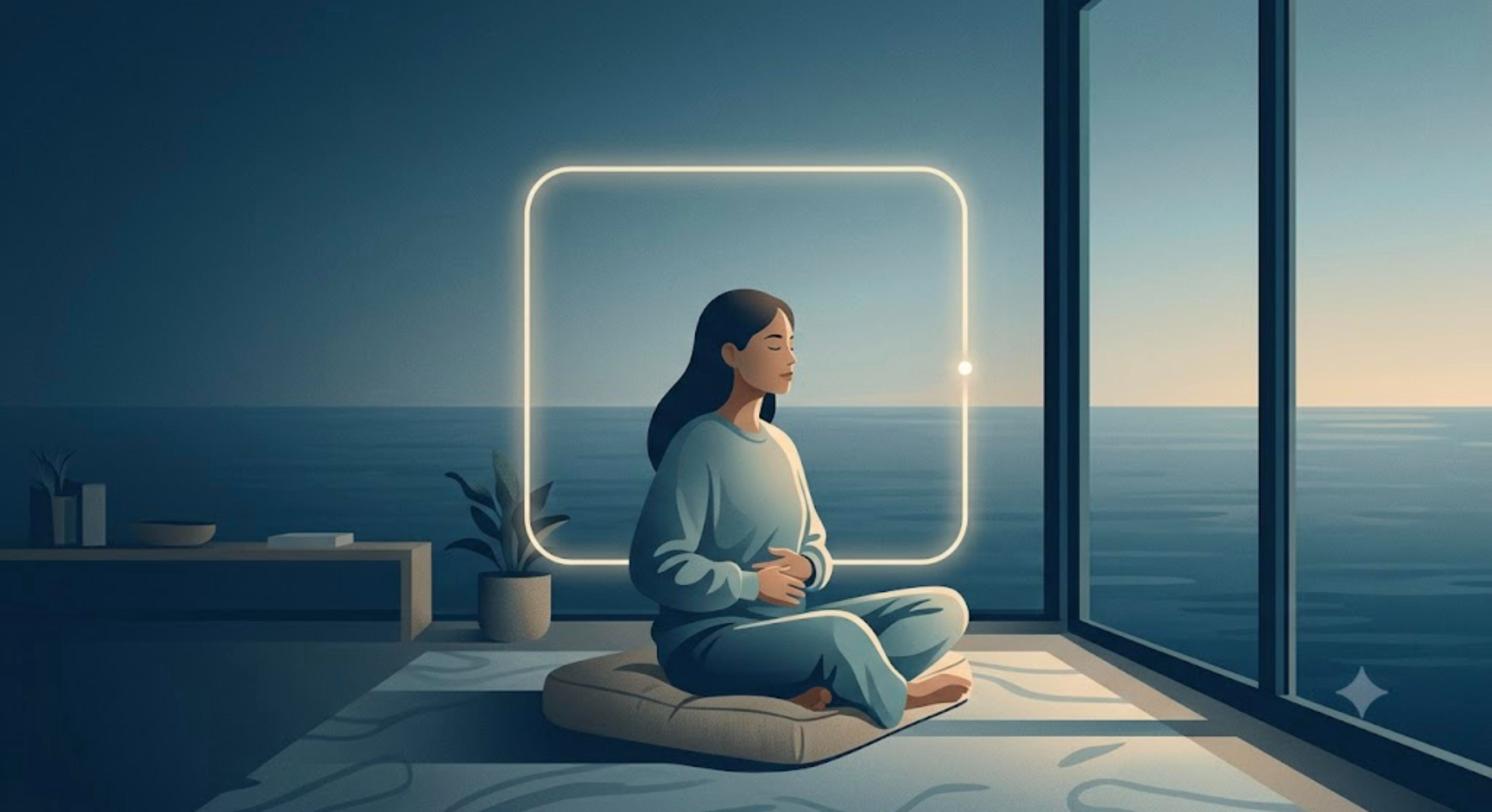
You've probably seen box breathing described as the Navy SEAL trick for staying calm under pressure. The reality is less dramatic and more useful: it's a simple, structured way to slow your breathing down, and you can do it anywhere without anyone noticing.
Here's exactly how to do it, how to adjust it if four seconds feels wrong, what the research does and doesn't show, and when another technique might suit you better.
What is box breathing?
Box breathing is a slow breathing pattern with four equal parts, like the four sides of a square. You breathe in, hold, breathe out and hold again, each for the same count. It's also called square breathing or four-square breathing. In yoga, a similar even-paced practice is called sama vritti, which roughly means "equal breathing".
The equal counts give your mind something simple to follow, and the holds naturally slow everything down. At 4 seconds per side, one full box takes 16 seconds, which works out to under 4 breaths a minute. A typical resting rate is somewhere around 12 to 20.
How to do box breathing, step by step
Sit comfortably with your back supported and your feet on the floor, or lie down. Rest your hands on your belly if that helps you feel your breathing.
- Breathe out fully through your mouth to start with empty lungs.
- Breathe in through your nose for 4 seconds. Let your belly expand, not just your chest.
- Hold for 4 seconds. Keep your shoulders and jaw soft. Don't clamp your throat shut.
- Breathe out through your mouth for 4 seconds, slowly and evenly.
- Hold for 4 seconds with your lungs empty.
- Repeat for 4 to 5 minutes, or at least four rounds if you're short on time.
| Side of the box | What you do | Count |
|---|---|---|
| 1 | Breathe in through your nose | 4 |
| 2 | Hold, lungs full | 4 |
| 3 | Breathe out through your mouth | 4 |
| 4 | Hold, lungs empty | 4 |
If four seconds feels wrong
Four is a starting point, not a rule. The Stanford researchers set each person's count from a simple breathing test, anywhere from about 3 to 10 seconds.
- Feel short of breath or light-headed? Drop to 3-3-3-3, or shorten just the holds.
- Find 4 seconds too easy? Try 5-5-5-5 or 6-6-6-6. Longer isn't better if it makes you strain.
- The holds make you anxious? Skip them. Breathe in for 4 and out for 6. You still get slow breathing, without the part that some people find uncomfortable.
The right count is the one where you finish feeling calmer than when you started, not out of breath.
Why is it linked to the Navy SEALs?
The name and the military reputation mostly come from Mark Divine, a former US Navy SEAL commander who has written and taught about box breathing for years. In his own account, he learned breath control through martial arts during his SEAL training and drew on yoga practice, and he called the four-part version "box breathing". Similar "tactical breathing" methods have been taught to soldiers, police officers and first responders to help them stay steady under stress.
So the story is real, but the technique isn't a military invention. Even, paced breathing has been part of yoga for centuries.
What the research says
Box breathing on its own has only a handful of studies, but it belongs to a well-researched family: slow, controlled breathing.
Slow breathing is linked to calmer states. A 2018 systematic review of 15 studies looked at breathing at fewer than 10 breaths a minute in healthy adults. Slow breathing was linked to higher heart rate variability, a marker of a more flexible, less stressed nervous system, and to feeling more relaxed and less anxious (Zaccaro et al., 2018).
Breathwork reduces stress, modestly. A 2023 meta-analysis pooled 12 randomised trials with 785 adults. Breathwork led to a small-to-medium reduction in stress, with similar effects on anxiety and low mood (Fincham et al., 2023). The authors noted that many studies had some risk of bias and warned against overhyping the results.
Box breathing works, but a long exhale may work a little better. In a 2023 Stanford trial, 108 adults practised for 5 minutes a day for 28 days. They used one of three breathing techniques or mindfulness meditation. The box breathing group felt more positive and less anxious by the end, a similar improvement to the meditation group. The group doing cyclic sighing improved most on mood, and their breathing rate slowed the most. That technique is two inhales through the nose followed by a long, slow exhale (Balban et al., 2023).
When box breathing helps most
- Before something stressful, such as a presentation, an exam, a difficult call or a job interview. A few rounds in the bathroom or at your desk is enough.
- Right after a jolt, like a stressful email, a near-miss in traffic or an argument, to bring your breathing back down.
- When your thoughts are racing and you need something simple to focus on.
- As a daily reset. The study above used 5 minutes a day. A regular slot, such as after lunch or before bed, makes it easier to use in the moment when you need it.
For falling asleep, many people prefer a gentler rhythm without holds, such as breathing in for 4 and out for 6. Holding your breath can feel slightly alerting, which isn't what you want at 1 AM.
Play rain sounds nowFree in your browser, with a sleep timer that fades outBox breathing vs other breathing techniques
| Technique | Pattern | Feels like | Good for |
|---|---|---|---|
| Box breathing | In 4, hold 4, out 4, hold 4 | Structured, focusing | Steadying yourself before or after stress |
| Cyclic sighing | Two inhales through the nose, then a long exhale | Releasing, softening | Quick relief, mood |
| 4-7-8 breathing | In 4, hold 7, out 8 | Slow, heavy, sleepy | Winding down at night |
| Coherent breathing | In and out evenly, about 5–6 breaths a minute | Smooth, rhythmic | Longer sessions, building a habit |
None of these is "the best". If box breathing feels like a chore, try one of the others for a week and see which one you actually keep using.
Who should be careful
Making it a habit
The hardest part of any breathing exercise is remembering to do it. A few things help:
- Tie it to something you already do, such as after you sit down at your desk, before you open your laptop or while the kettle boils.
- Keep it short. Four rounds take about a minute. Five minutes is plenty.
- Use the same quiet sound each time. A steady background sound like soft rain blocks out distractions and, after a while, becomes a cue that it's time to slow down.
nive doesn't count your breaths for you, but it can give you a quiet room to do it in. In the nive app, InstaRest has a one-tap Stress Relief mix, and you can build your own calm mix from rain, ocean waves or a singing bowl, then let Sleep Mode fade it out if you're practising in bed. For a quick start, try the free rain sounds player in your browser.
FAQ
How long should you do box breathing?
Four rounds take about a minute and are often enough to take the edge off a stressful moment. For a daily practice, aim for around 5 minutes, which is what the 2023 Stanford study used. Longer sessions are fine if they feel good, but they aren't necessary.
Does box breathing really work for anxiety?
For everyday stress and anxious moments, there's reasonable evidence. Slow breathing is linked to feeling calmer, and in a 2023 trial, 5 minutes of daily box breathing lowered anxiety about as much as mindfulness meditation. It isn't a treatment for an anxiety disorder, so talk to a doctor if anxiety is affecting your daily life.
Is box breathing good for sleep?
It can help you settle, but some people find the breath holds slightly alerting. At bedtime, try a softer version without holds, such as breathing in for 4 and out for 6, or a technique with a long exhale like 4-7-8.
Why do Navy SEALs use box breathing?
The technique became famous through Mark Divine, a former Navy SEAL commander who teaches it as a way to stay calm and focused under pressure. Similar "tactical breathing" is taught to soldiers, police and first responders. The pattern itself is much older and comes from yoga.
What's the difference between box breathing and 4-7-8 breathing?
Box breathing uses four equal counts: in, hold, out, hold. 4-7-8 breathing has a long hold and an even longer exhale: in for 4, hold for 7, out for 8. Box breathing tends to feel focusing, while 4-7-8 feels heavier and is often used to wind down for sleep.
Can box breathing be harmful?
It's safe for most people. If you feel dizzy, light-headed or short of breath, shorten the counts or stop and breathe normally. If you're pregnant, have a heart or lung condition, or get panic attacks, go easy on the breath holds and check with your doctor.
Sources
- Balban MY, Neri E, Kogon MM, et al. Brief structured respiration practices enhance mood and reduce physiological arousal. Cell Reports Medicine, 2023.
- Fincham GW, Strauss C, Montero-Marin J, Cavanagh K. Effect of breathwork on stress and mental health: a meta-analysis of randomised-controlled trials. Scientific Reports, 2023.
- Zaccaro A, et al. How breath-control can change your life: a systematic review on psycho-physiological correlates of slow breathing. Frontiers in Human Neuroscience, 2018.
This article is for general information and isn't medical advice. nive is a relaxation app, not a treatment for anxiety or any other condition.
Take it to bed with you
nive mixes up to six sounds, fades them to silence with Sleep Mode, works offline and plays on Google Cast, AirPlay and Alexa. On Android now with a 7-day free trial, then $2.99 a month or $19.99 a year.
Start your free trial