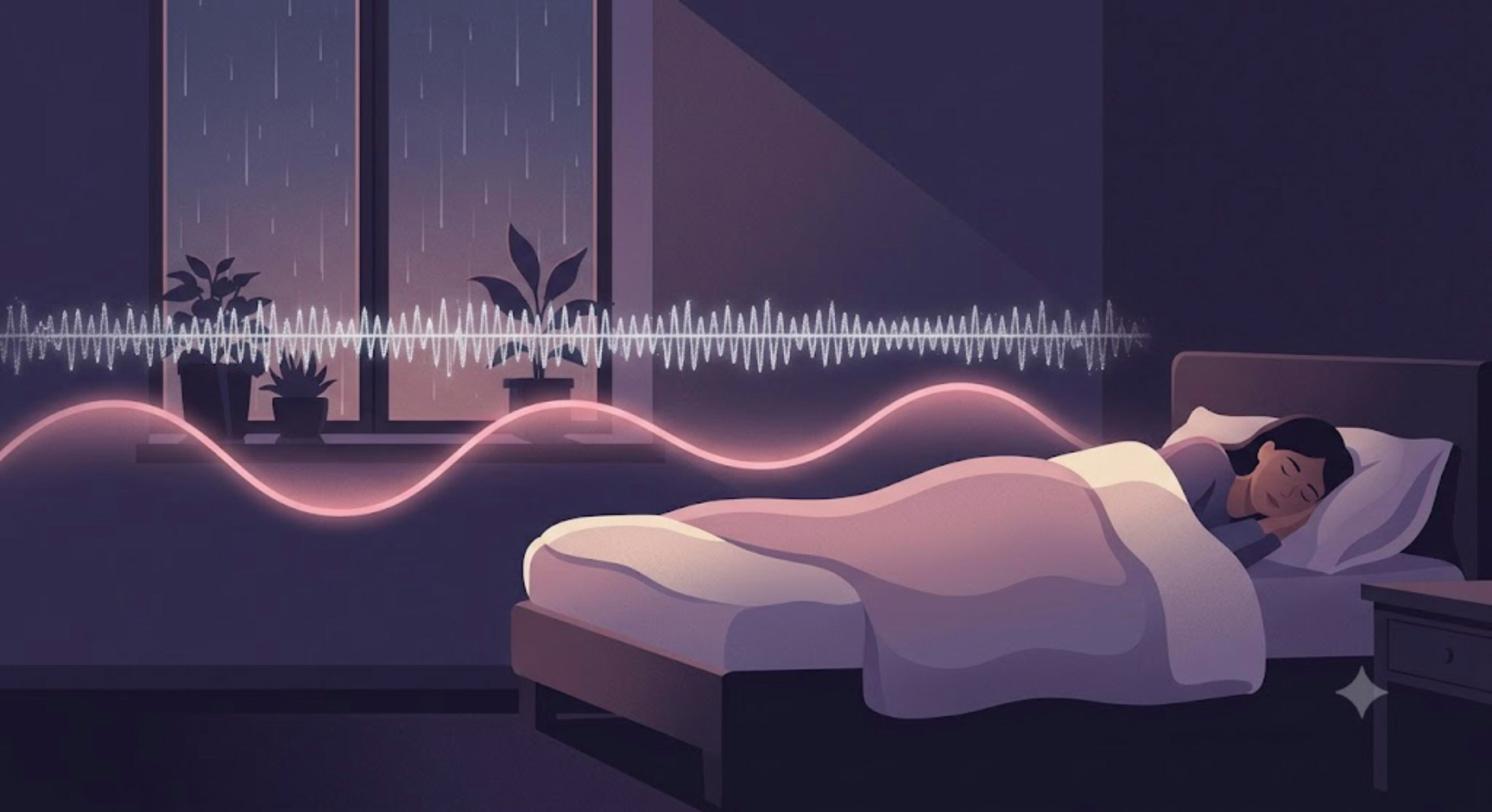
Pink noise is often described as the "better" white noise: softer, more natural and supposedly scientifically proven to deepen sleep. Some of that is true. Some of it comes from headlines about lab studies that work very differently from the pink noise track on your phone.
Here's how the two sounds really differ, what the research actually found, and how to choose between them.
The short answer
For most people, pink noise is the more comfortable choice for sleep, and white noise is the stronger mask. Pink noise has less high-pitched hiss, so it's easier to listen to for hours. White noise is fuller in the higher frequencies where voices and sharp sounds sit, so it hides them better.
Neither has strong evidence that it improves sleep on its own when played continuously. Both mostly help by covering the sudden noises that wake you.
Play pink noise nowFree in your browser, with a sleep timer that fades outWhat's the difference between pink and white noise?
Both are random, steady sound. What differs is how their energy is spread across low and high pitches.
- White noise has equal power at every frequency. Each octave up contains twice as many frequencies as the one below it, so most of white noise's energy ends up in the high end. That's why it sounds like a sharp shhhh or TV static.
- Pink noise loses about 3 decibels with every octave you go up. That balances things out so each octave carries the same energy. The result sounds smoother and deeper, like steady rain, wind in trees or a distant waterfall.
Our ears also play a part. Human hearing is most sensitive in the middle-to-high range, roughly 2,000 to 5,000 Hz, exactly where white noise is strongest. Pink noise eases off there, which is why it often feels gentler at the same volume.
Pink noise vs white noise, side by side
| White noise | Pink noise | |
|---|---|---|
| Energy | Equal at every frequency | Equal in every octave (drops 3 dB per octave) |
| Sounds like | TV static, a hissing fan, a running tap | Steady rain, wind, a distant waterfall |
| Feels | Bright, sharp, can be tiring | Soft, balanced, natural |
| Best at covering | Voices, TV, high-pitched sounds | A mix of everyday noises |
| Sleep research | Some studies on falling asleep, mixed overall | Lab studies on timed bursts, a few on continuous play |
| Try it if | Talking or TV keeps you awake | You find white noise harsh |
If you want something deeper still, brown noise goes further than pink. Our guide to brown noise vs white noise covers that side of the spectrum.
What the research says about pink noise
The headline studies: timed bursts in a sleep lab
Pink noise became famous because of research on deep sleep and memory. In 2013, German researchers played short sounds to sleeping volunteers, timed precisely to the peaks of their slow brain waves during deep sleep. The slow waves grew stronger, and the next morning participants remembered more word pairs they'd learned the evening before. Sounds played at the wrong moment in the wave didn't help (Ngo et al., 2013).
A 2017 study at Northwestern University tried a similar approach in 13 adults aged 60 to 84. Short bursts of pink noise were timed to their slow waves using a real-time brain monitor. Their overnight improvement in word recall was greater than on a night without the sounds, although total deep-sleep activity across the whole night didn't change (Papalambros et al., 2017).
These are genuinely interesting findings. But notice what they tested: brief bursts of sound, triggered by a brain-wave recording, at exactly the right millisecond. A pink noise track playing on a loop can't do that.
The evidence has become less clear
As more studies were published, the memory effect looked smaller. A 2023 review of 14 studies found that the benefit for memory had steadily shrunk over the years, with recent studies showing little or no effect (Harlow et al., 2023). An earlier meta-analysis that reported a large memory boost was later retracted after errors were found in its data.
What about pink noise played all night?
There's much less research on a steady pink noise track, which is how most people use it:
- In a 2012 study of 40 adults, steady pink noise during the night was linked to more "stable sleep". That was measured indirectly from heart and breathing signals rather than brain waves (Zhou et al., 2012).
- In a 2023 study, 72 students slept at home with or without pink noise playing all night at 55 dB. The pink noise group spent more time in light sleep, with no change in deep sleep. They also solved fewer problems that needed a flash of insight the next morning, though the numbers were small (Vickrey and Lerner, 2023).
What the research says about white noise
White noise research is mostly about falling asleep and masking. In a small lab trial, 18 adults fell asleep faster, about 13 minutes instead of 19, with gentle broadband sound playing at 46 dB (Messineo et al., 2017). But a 2021 review of 38 studies rated the overall evidence for continuous noise as a sleep aid as very low quality, with mixed results (Riedy et al., 2021).
For focus, both colours have some support. A 2024 meta-analysis of 13 studies found that white and pink noise gave a small benefit on attention tasks for people with ADHD or high ADHD symptoms (Nigg et al., 2024).
Play white noise nowFree in your browser, with a sleep timer that fades outWhich should you choose?
| Your situation | Try first | Why |
|---|---|---|
| Voices or TV through the wall | White | Strongest in the range where speech sits |
| You find white noise harsh or tiring | Pink | Less hiss, smoother sound |
| Traffic, bass or a snoring partner | Pink, then brown | More low-frequency body to cover rumbles |
| Light sleeper who wakes at small sounds | Pink | Comfortable enough to leave on longer |
| Studying or focused work | Either | Both showed small benefits for attention |
| Babies | Whichever is quietest | Volume and distance matter more than colour |
The best test is your own ears. Try each one for a few nights at the same low volume, and keep the one you stop noticing.
How to use pink or white noise for sleep
- Keep it quiet. Set it just loud enough that the sounds bothering you blend in, well below conversation level.
- Put the speaker across the room, not by your head or in a baby's cot.
- Use a fade-out timer if you only need help falling asleep. Given the mixed findings on all-night noise, there's no reason to keep it on longer than you need.
- Stay consistent. Using the same sound every night turns it into a cue that it's time to sleep.
If you like natural sounds, rain is a good pink-like option. Our guide to rain sounds for sleeping explains which kind to choose. For another soft option, see what green noise is.
Pink and white noise in nive
The free pink noise and white noise players on this site run in your browser, with no ads and a sleep timer that fades out gradually.
In the nive app, you can go further. Blend pink noise with rain, or layer a little brown noise underneath, balance each sound, and save it as your own mix. Sleep Mode then lowers the volume a tiny amount every minute until the room is silent, so you get the masking while you fall asleep and quiet once you're there.
FAQ
Is pink noise better than white noise for sleep?
Many people find it more comfortable because it has less high-pitched hiss, but there's no strong evidence that playing pink noise all night improves sleep more than white noise. Both mainly help by masking disruptive sounds. Try both at a low volume and keep the one you prefer.
Does pink noise improve deep sleep and memory?
In lab studies, short bursts of sound timed precisely to deep-sleep brain waves increased those waves and improved next-day word recall. Playing a pink noise track continuously is different, and recent reviews suggest the memory effect is smaller than first reported.
What does pink noise sound like?
Like steady rain, wind in trees or a distant waterfall: a soft, even sound with more depth and less hiss than white noise.
Is it safe to sleep with pink noise every night?
At a low volume, there's no evidence that it's harmful for adults. Keep it quiet, keep the speaker away from your head and use a fade-out timer if you don't need it all night. One small study found that all-night pink noise increased light sleep, so there's no need to run it longer than it helps.
What's the difference between pink noise and brown noise?
Pink noise drops by about 3 dB per octave, and brown noise drops by about 6 dB per octave. Brown noise is deeper and rumblier, like distant thunder, while pink noise sounds more like steady rain.
Is pink or white noise better for studying?
Either can help. A 2024 meta-analysis found that both white and pink noise gave a small boost on attention tasks for people with ADHD symptoms. Choose the one you find least distracting, and keep it at a low volume.
Sources
- Ngo HVV, Martinetz T, Born J, Mölle M. Auditory closed-loop stimulation of the sleep slow oscillation enhances memory. Neuron, 2013.
- Papalambros NA, et al. Acoustic enhancement of sleep slow oscillations and concomitant memory improvement in older adults. Frontiers in Human Neuroscience, 2017.
- Harlow TJ, Jané MB, Read HL, Chrobak JJ. Memory retention following acoustic stimulation in slow-wave sleep: a meta-analytic review of replicability and measurement quality. Frontiers in Sleep, 2023.
- Zhou J, et al. Pink noise: effect on complexity synchronization of brain activity and sleep consolidation. Journal of Theoretical Biology, 2012.
- Vickrey B, Lerner I. Overnight exposure to pink noise could jeopardize sleep-dependent insight and pattern detection. Frontiers in Human Neuroscience, 2023.
- Messineo L, et al. Broadband sound administration improves sleep onset latency in healthy subjects in a model of transient insomnia. Frontiers in Neurology, 2017.
- Riedy SM, Smith MG, Rocha S, Basner M. Noise as a sleep aid: a systematic review. Sleep Medicine Reviews, 2021.
- Nigg JT, et al. Systematic review and meta-analysis: do white noise and pink noise help with attention in ADHD? Journal of the American Academy of Child & Adolescent Psychiatry, 2024.
This article is for general information and isn't medical advice. nive is a relaxation app, not a treatment for insomnia or any other condition.
Take it to bed with you
nive mixes up to six sounds, fades them to silence with Sleep Mode, works offline and plays on Google Cast, AirPlay and Alexa. Free on iPhone and Android with no ads; Premium is $0.99 a month or $9.99 a year, with a 7-day free trial.